

PIXAR
To Infinity and Beyond


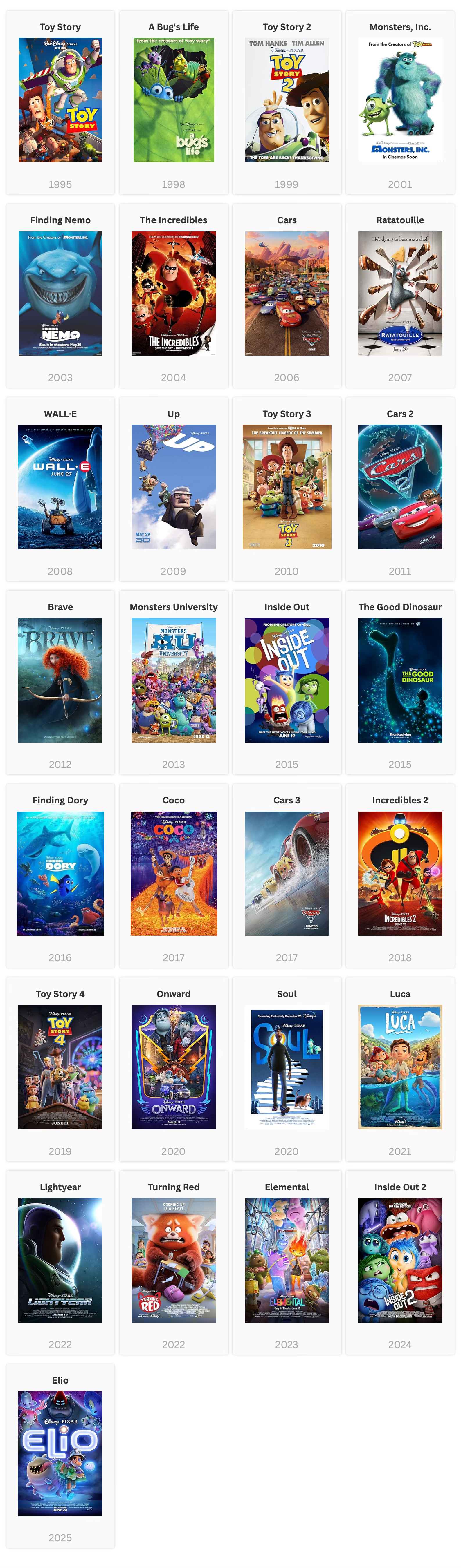
What started as a computer graphics division inside Lucasfilm in the 1970s eventually grew into one of the world’s most innovative storytelling companies. With around 1,200 employees in total, Pixar is one of the most well known animation studios in the industry and this post is a fun and quick look at the movies that have made the company what it is today.
Pixar has been owned by Disney since 2006 (in a deal that made Apple’s Steve Jobs the largest single shareholder), but their relationship dates all the way back to the 1980s and into the 1990s where their deep pockets helped Toy Story become the first feature-length film created entirely with computers. Since then, the unique culture and talent at Pixar has gone on to bring 29 feature-length movies to existence.
Reception
Pixar makes really good movies. I guess that depends on who you ask, but according to Rotten Tomatoes, Pixar has produced more hits than failures. (Then again, Rotten Tomatoes unfairly gave the 2014 movie Tammy a 24% out of 100%. )
The original Toy Story stands with a 100% according to Rotten Tomatoes and the first sequel, Toy Story 2, miraculously also earns a perfect score. In the above chart, you can see that sequels aren’t necessarily worse than new ideas when it comes to ratings. Notably, Cars 2 has scored the worst, but then again, the original Cars wasn’t a Rotten favorite but it probably scores a 99% according to 3-10 year old kids.

Another respected movie rating website, IMDB, is a little more harsh when it comes to ratings. Wall-E and Coco eked out just slightly higher than Toy Story as the best rated Pixar movies with both earning an 8.4/10.
It’s worth noting, for reference, that the absolute highest rated film according to IMBD is The Shawshank Redemption which only scored 9.3/10. A great rating from strangers and movie critics doesn’t necessarily mean a successful film, though, according the movie studio.
Box Office
In today’s streaming world, Box Office might seem like an archaic way to measure the financial success of a film, but it still holds a lot of weight. Box Office in this context means the gross dollar amount earned from tickets sales in theaters in the US. So the below are not international numbers, profit, or Disney+ subscriptions—but money made from movie tickets sold.
It’s easy to see that there isn’t a real pattern of an increase or decrease in box office returns or even any real relationship between these numbers and the ratings above. (There’s no point in showing the plot.) The COVID-19 pandemic certainly affected movies like Soul and Luca which had very limited theatrical runs. One of the most recent Pixar films, Inside Out 2, a sequel to the 2015 movie, became the highest grossing animated film of all time with more than $650 million in box office alone. And now anyone can watch it streaming on their couch.
The Gross Revenue below includes ticket sales worldwide and though it looks similar to the above, the chart gives you an idea of the difference in raw numbers:
The lack of a “normal” theatrical release certainly harmed films like Luca (which is awesome, by the way). But it’s fascinating to see the difference between US and International gross. Below is the ratio between US and Global box office, which is literally just one number divided by the other and the actual number means nothing by itself. But when you compare them, you can see how some films were huge hits outside of the US. The higher the number, the bigger the success outside of the US compared to domestically.
Coco is a movie centered around Dia de los Muertos (“the day of the dead”) which is a widely celebrated holiday in Mexico and the other parts of Latin America. And because of that, Coco went on to become the highest grossing film ever in Mexico when it was debuted. (It also did really well in China.) Compare that to the the original Toy Story which, being the first ever Pixar film in the 1990s, seemed to have much less international success.
We know in round numbers and general estimates how much a film cost to make, but it’s difficult to know how much money a film actually profited because of so many variables that are not published or public knowledge. The cost of the cast, crew, orchestra, technology, and the like goes into the the widely available production costs but advertising, “points” and residuals, behind-the-scenes contracts, etc. is all but a mystery for most films.
So you cannot simply subtract production costs from gross revenue. So here is a chart of production costs subtracted from gross revenue:
We cannot see in this chart how many people signed up for Disney+ to watch the movie or how many people clicked “Rent” on their Apple TV, but it does give a general sense of how financially successful each of these Pixar movies is. Since marketing budgets alone are sometimes as high as production costs, it’s safe to say that Pixar/Disney were not happy about the financial success of films like Turning Red or Lightyear in recent years whose production costs alone likely outweighed the gross revenue, but Inside Out 2 has certainly made up for some of that disappointment.
Along the lines of profit, when it comes to when to release a movie, the film industry has figured it out. And Pixar undoubtedly has done the math. Since one of the largest target markets for the studio is kids and families, it’s especially apparent: school is out in the summer and school is out during winter break. Even the three films released directly to streaming seem to fall in line. (Turning Red and Onward were released during “Spring Break” technically.)
In fact, in 2005 before the Disney purchase, the Pixar chairman, none other than Steve Jobs, went against the Disney CEO Michael Eisner when he decided to push the release of Cars until the summer. The motivation for the decision was that the movie would make more money in the summer and then would have another showing during the holidays in December when you could sell the DVD release. Only 3 Pixar films have been released in the December since then.
The People
Behind each Pixar film is a large, diverse creative team. Or maybe not? “If it ain’t broke, don’t fix it.”
Pixar has had great successes and is an industry leader in storytelling, so it makes sense that they keep using much of the same talent in their filmmaking. Some of the most well known names like Pete Docter and Andrew Stanton have had a huge part in writing the classics we all love today.
The directors list has a similar pattern of a close-knit, talented community. Even those with a single directing or co-directing credit have storyboard or other credits within Pixar.
But if you think having a few writers or directors responsible for multiple Pixar movies is a lot, check out the number of voice actors that have played so many different roles in Pixar’s 29 films:
Beginning with the original Toy Story, John Ratzenberger has voiced a character in almost every Pixar film. Even in the film Wall-E, which is mostly free of any dialogue except for some beeps and computer voices, John has a featured role. Also of note on the list above is Bill Farmer, most widely known for being the voice of Goofy for the last 35+ years, who has provided numerous “additional voices” all the way back to Toy Story.
Music
You don’t have to be a music buff to realize that Pixar has used a lot of the same film composers over the years. We all know that Randy Newman (“You’ve Got a Friend in Me”) has provided music for at least a few films. But it’s fascinating to see how Pixar films have repeatedly used a small handful of composers again and again.
Randy Newman and his 15-time-Oscar-nominated-but-never-won cousin Thomas Newman have made almost 50% of the Pixar film scores over the last 30 years. Add in Michael Giacchino (of The Incredibles and Ratatouille) and there are only eight films scored by other composers.
Many of these are brilliant, iconic scores. But the actual music that we know and love was played by some of the best musicians in the country, and surprise, it’s a lot of the same musicians again and again. Here is just a very small snippet of some of the musicians credited on multiple films:
For 99% of the population, these are just random names that nobody has ever heard of, but they’re some of the most prolific musicians in the music industry. George Doering at the top of the list (excluding the Music Producers credited with 27 films), has played on over 800 films since the 1970s. Jon Lewis’s brilliant trumpet playing can be heard in the film Coco and something that was surely impressive at the time but now maybe not something to brag about, a Diddy album. (Okay, it’s still cool.) And not included (because of truncating the list) are those like Randy Kerber, the pianist responsible for the some of the most iconic piano and keyboard music ever in films like the “Feather Theme” from Forrest Gump, the famous celesta solos in Harry Potter, and the hauntingly beautiful piano in the blockbuster Titanic (along with 7 Pixar credits).
If you sort this list above but include every musician who has played on multiple Pixar films, you’ll get 687 musicians. More than 300 musicians alone have played on 5 or more Pixar films.
The Future
In 2026, Pixar is slated to release two new feature-length films: Hoppers and Toy Story 5. Andrew Stanton returns to Pixar to direct his first Toy Story film and Randy Newman returns to score his 5th. A few years down the line we can expect both new originals and even a Coco 2. It looks like Pixar has many years of fantastic new storytelling ahead of it. Adventure is out there!
P.S. I tried to find any correlation or causation between how long a Pixar movie is, how good it is rated, how much money it’s made, whether the movies are getting longer over time, and whether Armen Ksajikian’s cello playing affected any of that. Nothing. Here’s a runtime chart anytime.