

Mediaite
2025 in Media, News, and Politics

This post includes many interactive charts. For the best experience, read in a browser instead of in your inbox.
Founded back in 2009, Mediaite.com is a news site that The Washington Post’s Jeremy Barr described, “chronicles the intersection of media and politics.” A sort-of unicorn in its space, Mediaite reports the news just as much as it reports on the news reporting the news.
Media mogul and legal analyst Dan Abrams started Mediate after making a name for himself in the news and media business as an analyst, TV host, and in the late 2000s, General Manager of MSNBC. Mediaite is a heavily trafficked media site despite its modest staff size. At the end of 2024, the editor in chief announced the website had hit a yearly record of 760 million views. (Compare that to CNN or NYT’s 5+ billion views to see its place in the media landscape.)
This analysis is a deep dive into what has been published since the beginning of 2025. In looking at just over 4 months worth of content, we can see how the news business as a whole has covered major controversies and the politics of the day.
A Slew of News
Since January 1, Inauguration Day (January 20) was the day that saw the most new articles published at Mediaite with 64 articles. Perhaps Lionel Richie’s birthday contributed to the influx of new articles, as well. (EDIT: Not a single mention.) That day’s number was just slightly higher that most week days, though.
Mediate publishes on average 40 articles per day. Though the average probably isn’t the best measure here because of the high standard deviation (about 12 articles a day). You see, just like most of us, Mediaite enjoys the weekends.
I’ve never seen a trend more clear than Mediaite’s weekday vs. weekend publishing rate. I think they’re very good to their employees and they mostly get the weekends to themselves.
In the last 4 months, if Saturday and Sunday were a single day, Sunterday would still be the lightest day when it comes to the quantity of articles published.
The news certainly doesn’t stop on the weekends, but to be fair, most people prefer not to be stressed on Saturday and Sunday by reading the news. Good business decision.
Mediaite, like Washington D.C. and many major news publications, is based in the EST/EDT timezone. That previous sentence was a complete guess, but judging by the times that articles have been published the past 4 months, I’d be willing to wager quite a bit on it. There has yet to be a single article out of the 4,100 or so in this analysis that was published in the 4a EST hour.
What’s interesting is that there tends to be more Mediaite articles published as the morning goes on. Compare this with, for example, The New York Times which publishes more articles online at around the 5a hour than the rest of the day combined. Whereas The NYT has a physical daily printing to contend with, Mediaite has always been a completely digital product. Also, much of Mediaite’s news coverage is that of the media itself which means it needs content from politicians, hosts, and guests doing morning talk show hits and the writers need time to synthesize and analyze other long form reporting published at 5a.
Who is Writing?
In a previous analysis of The New York Times, the data showed more than 1,300 people had bylines or had their work published in the span of a year. At Mediaite in the first 4 months, less than 30 individuals were responsible for all of the content.
In about 100 days, the bulk of the Mediaite staff has been rather busy publishing multiple articles per day on average. Compare the top writer in terms of output at Mediaite, Kipp Jones, who has his name on 462 stories with the journalist at the NYT who in the aforementioned NYT Analysis had the most articles published. That was Maggie Haberman with 346 stories in the period of one year.
This is certainly not to say that Maggie Haberman needs to work more or that Kipp Jones is working too much. Mediaite does a great job at getting right to the point when reporting news that is often broken and reported elsewhere first. Many of the website’s content consists of succinct summaries of long[er] form journalism from other publications. I’m assuming that The NYT has a very different profit structure, too, when it comes to subscribers vs. ad revenue. (Mediaite is probably kicking themselves for not having purchased Wordle first.)
In its analyses of the media landscape, Mediaite links to stories and articles from dozens (technically hundreds) of publications and media entities. Each article on average contains 4 or 5 links to other Mediaite content or external sources. By analyzing all of the hyperlinks in every article, we can extract the domains most linked. The top few news entities are below.
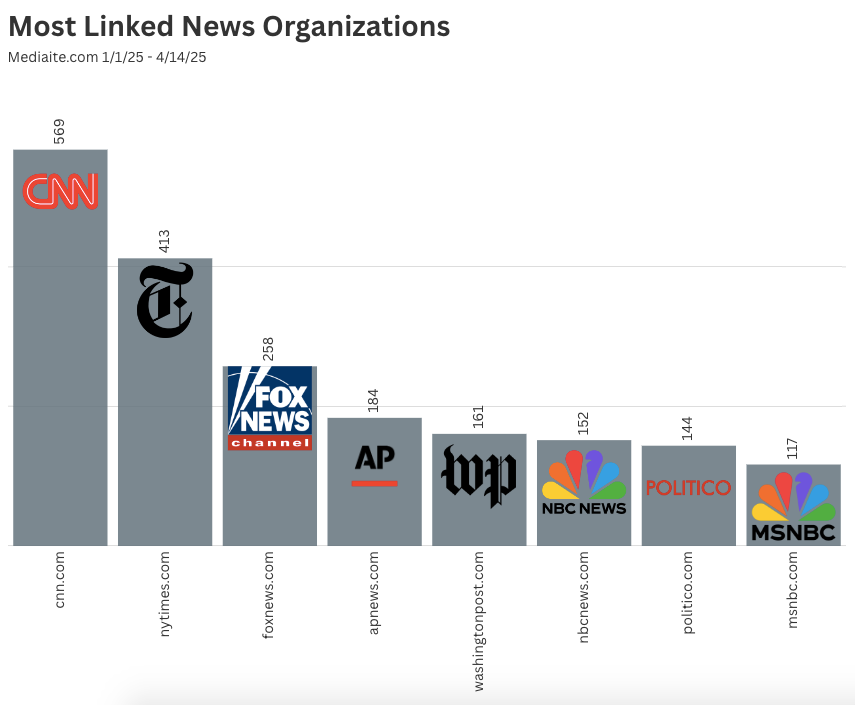
Not in the above graphic, Twitter/X is by far the most commonly linked domain name (outside of Mediaite’s itself). A large percentage of stories on Mediaite have Twitter/X embeds in the story which are frequently first-hand statements from public officials, journalists, and analysts. Also in the top 10 (but not above as it’s also not a news organization) is Truth Social. I haven’t checked all 223 instances of the Trump social media embeds, but I cannot imagine there are literally any “truths” linked to other than those of the owner himself. Here’s a more complete chart of all of the hyperlinks in the articles:
You’re It
Mediaite’s writers and editors utilize multiple “tags” for every article published which act as helpful categorizers of the stories. There are over 3,000 tags because you never know when you might want to group all of the “soulja-boy” articles together. (The answer has been never so far this year, though that is a real tag and can be utilized in the future I guess?) The most common tags are probably not surprises for most.
Since Mediaite covers a broad spectrum of media, from liberal to conservative, print to international television, serious to silly, the tags above are a pretty good indicator of what the media as a whole has been focused on in the past 4 months. Not surprisingly Trump garners more media attention by far than any other person or topic. I was nice to the Vice President and displayed 20 tags instead of 10 per page as to not bump him back to the second page alongside “morning-joe” (no disrespect to Mika and Joe—they are certainly newsworthy—but JD is giving off tertiary character vibes).
More evidence of Mediaite reporting on the media as a whole is Scott Jennings, CNN’s highly paid antagonist, getting more attention than most of the Trump administration’s Cabinet. Outrage certainly sells which is likely the reason Jennings got a recent raise despite most CNN viewers not being the biggest of fans.
The editor-added tags, as useful as they might be, don’t quite describe the articles as well as the writing itself, however.
Text Analysis
The data set contains 41,000 articles which on average are approximately 460 words in length. The total word count over the past 4 months is 1,892,793. After removing the stop words (common words like “the” and “a”), there are about 8,500 unique words that were published by Mediaite. If that sounds like a small amount, it is estimated that the average person uses just 800-1000 unique words per day.
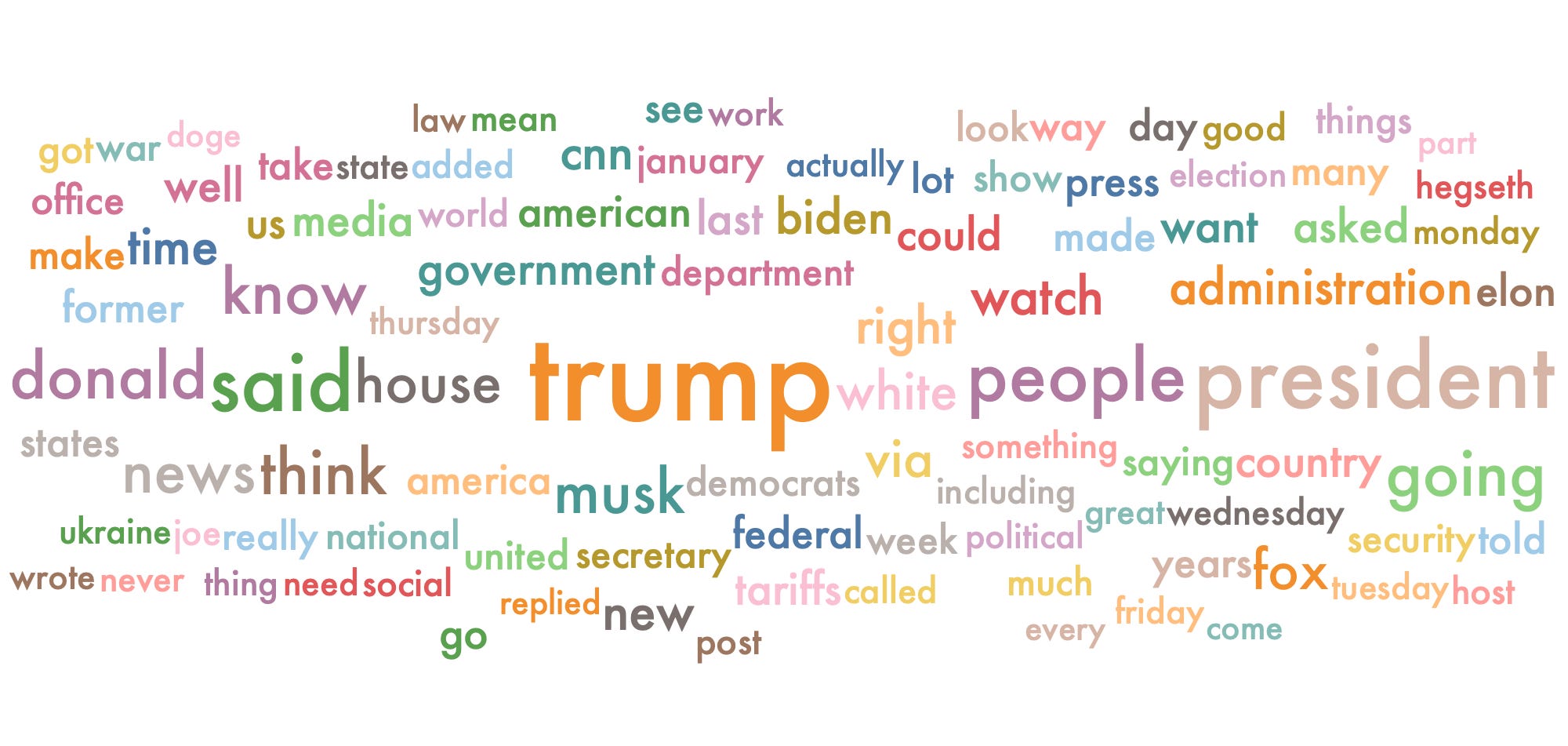
The word cloud above represents some of the most commonly used words and gives us a quick, unscientific glimpse of the content of Mediaite.
The word counts themselves give us an incredible wealth of information. As a news and politics media site, we can see who the world leaders (Donald Trump excluded) are that are mentioned most.
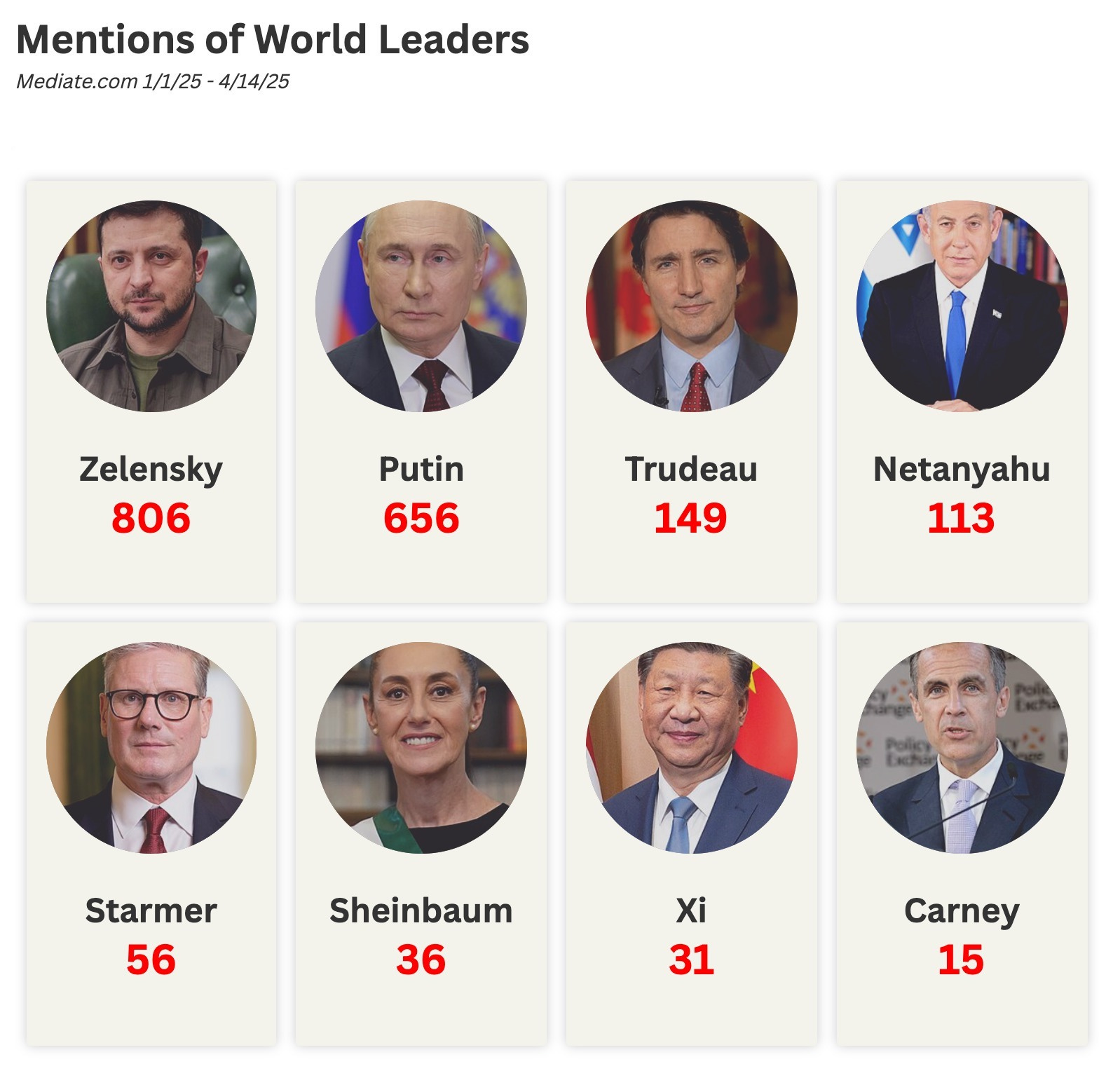
To be fair, most of these leaders are mentioned above so often because of their interactions with the United States President. That probably explains the much higher numbers for Trudeau, PM of Canada until mid-March compared to the current PM Carney who hasn’t butted heads as publicly with Trump.
For more fun, below is a world map with the number of articles that mention a country. (Note: Unlike the above, five mentions of Canada in one article would count as a single instance.)
There is some room for error in this analysis. The central African country of Chad (bonus points if you can find it without hovering for the label) was probably not name checked 11 times. There was more likely an interview with one of the Wizards of Wavery Place that contributed to that number. That being said, you can at a glance see the countries that are often in the news, and even some locations that should not be in the news had we been living in a normal world (i.e. Greenland).
Similarly, here is a map of just the United States and the number of times a state has been mentioned. All 50 states made the cut! The more people in the state (or the more controversial its governor or representives), the more mentions. Yay North Dakota.
What’s Trending
Grouping the dozens of daily articles into days and then into weeks, longer term trends start to become apparent. Even though Mediaite publishes 40+ articles a day, it’s clear to see that the news tends to focus on one large issue at a time.
The best thing to have happened to National Security Advisor Mike Waltz and Defense Secretary Hegseth was tariffs. “Signalgate” disappeared almost entirely from the news once Trump went to war with whatever it is that he’s gone to war with in global trade. RFK, Jr.’s head-scratching statements in January began to be overshadowed by Elon Musk and DOGE. And it almost seems as though the Greenland talk (pre-Inauguration Day) was just and attempt by the President too add something to the news cycle.
The above is messy if you look at it as a static image, but hover over individual lines to see how the trends interact with one another. The defunding of USAID (which correlates with DOGE at the beginning) slips gradually from the news as Musk began to send his “5 Things” emails and then that completely falls off as the stock market collapses because of tariffs. (Note: The chart is cut off at the top to even fit this on the page.)
Good News
This post is filled with a decent amount of gloom and chaos. Luckily there is a sliver of hope. And I’m not exaggerating when using that word. Taylor Swift has been mentioned in 16 articles this year.
Just whatever you do, don’t go searching for those articles.